

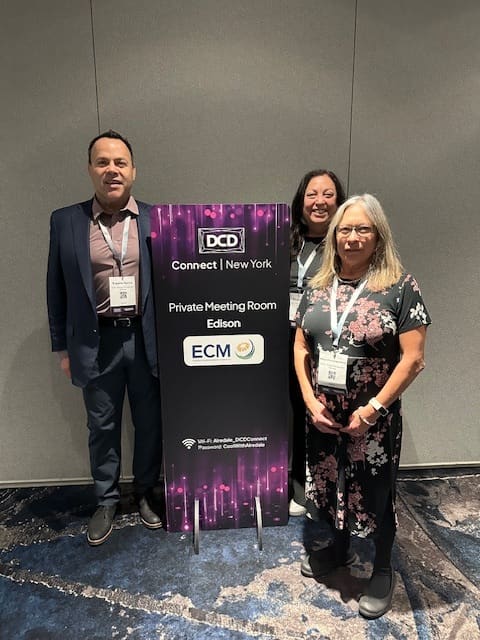
At DCD Connect NY, one theme came through clearly in nearly every conversation I had:
The data center industry is being pulled in two directions at once.
On one side, investors are pushing for faster deployment, accelerated growth, and rapid returns. On the other, the grid is pushing back—with constraints, delays, and increasing uncertainty.
The result is a growing tension. Data centers are being forced into decisions they don’t actually want to make.
And it raises a more important question than we’ve traditionally asked:
It’s no longer just “How do we get power?”
It’s “How do we secure power fast, without becoming something we’re not?”
Securing Power Is No Longer a Procurement Exercise
The most discussed topic at DCD was also the most fundamental: how to actually secure power in today’s environment.
What stood out is how much the old assumptions have broken down. Grid access is no longer a given. Timelines that once aligned with development cycles no longer do. Interconnection queues are longer, less predictable, and increasingly complex.
What this means in practice is that power strategy has shifted.
It’s no longer a transaction handled late in the development cycle. It’s now a strategic capability that must be addressed early, with multiple pathways in mind.
The organizations that are moving forward with confidence are the ones that have visibility into:
- Where capacity actually exists
- How ISO markets are evolving
- What timelines are realistic before capital is committed
“Bring Your Own Generation” : A Strategy Few Actually Want
One of the most talked-about strategies was also one of the most uncomfortable: bringing your own generation.
It’s becoming a common fallback when grid timelines don’t align with business needs.
But there’s a clear tension.
Investors are saying: “Build faster, solve it.”
Operators are saying: “We are not power generation companies.”
And that’s the reality.
Data centers are not choosing generation because it’s strategically ideal. They’re being pushed into it because the grid cannot meet their timelines.
The implications are significant:
- Capital is diverted into non-core assets
- Operational complexity increases
- Long-term risk profiles change
Most importantly, it pulls focus away from what these organizations are built to do.
Behind-the-Meter vs. Front-of-the-Meter Is a Business Decision
Another major discussion point was the role of behind-the-meter (BTM) versus front-of-the-meter (FTM) strategies.
This is often framed as a technical choice. It’s not.
It’s a business model decision.
Behind-the-meter solutions can offer speed and control in the short term. But they often come with operational burden, scalability limitations, and potential inefficiencies over time.
Front-of-the-meter strategies, by contrast, are more aligned with scalable, grid-integrated solutions; but they require deeper market understanding, regulatory navigation, and long-term planning.
The question isn’t simply where generation sits.
It’s how you want to operate as a business over the next decade.
The Reality No One Loves: “We Don’t Want to Be Generators”
Across hyperscalers, colocation providers, and enterprise operators, the message was consistent:
Stay focused on core business.
Avoid unnecessary operational distraction.
Minimize non-core risk.
And yet, many are being forced into interim generation strategies, hybrid models, and solutions that were never intended to be permanent.
What stood out to me is this:
The industry is solving a grid problem at the asset level, when it should be solving it at the market level.
Until that shift happens, we’ll continue to see inefficiencies, duplicated effort, and capital deployed in ways that don’t fully align with long-term goals.
Community Engagement Is Now a Critical Path Item
Another shift that is impossible to ignore: community engagement is no longer optional.
It is now a gating factor.
Projects are increasingly influenced by local perception, environmental concerns, and the tangible value delivered to the surrounding community.
What’s working today is early and transparent engagement—well before development decisions are finalized.
But there’s also a broader context that needs to be acknowledged.
In many regions, end-user electricity rates are rising, not because of any single project, but because the transmission system as a whole has not been maintained or upgraded at the pace required. Rate case funding has not always been deployed effectively, and now large-scale system upgrades are necessary.
If system upgrade costs are triggered by the addition of a specific project, that project is expected to bear those costs—this has been standard practice for decades. The challenge arises when utilities or transmission owners (TOs) previously received funding for system upgrades through rate cases but did not complete the necessary work. In cases where upgrades fall on the utility/TO side and have already been funded by ratepayers, any additional charges effectively require those same ratepayers to pay for the upgrades a second time; and they are aware of it. Developers who understand this dynamic and engage communities with transparency are seeing more constructive outcomes.
Because ultimately:
Community strategy is now part of power strategy.
Efficiency Is Emerging as a Capacity Strategy
One of the more nuanced, but important—takeaways was how the industry is reframing efficiency.
Efficiency is no longer just about cost savings or sustainability reporting.
It is now a capacity strategy.
Reducing load can:
- Free up capacity faster than waiting for new generation
- Reduce dependence on constrained infrastructure
- Provide immediate, measurable impact
In many cases, it is also more economically rational than rushing into new renewable deployments without a clear integration strategy.
In today’s environment:
The cleanest (and often fastest) megawatt is the one you don’t need to procure.
A New Energy Operating Model Is Emerging
What ties all of this together is a broader shift in how leading organizations are approaching energy.
We are moving away from linear procurement models toward integrated energy strategies.
The most effective teams are evaluating, in parallel:
- Grid access and interconnection pathways
- ISO market participation
- Generation (only where necessary)
- Efficiency and load optimization
- Demand-side flexibility
The advantage is no longer in any single lever.
It comes from integrating supply, demand, and market strategy—rather than solving each in isolation.
The Strategic Question Moving Forward
After DCD, the most important takeaway for leadership teams is this:
The question is no longer:
“How do we get power for this project?”
It is:
“What is our long-term strategy to secure power, control cost, and scale—without compromising our core business?”
A Final Thought
If you’re navigating these decisions today, you’re not alone. The challenges are real, but so are the opportunities to approach them differently.
At ECM, we work with large-load organizations to navigate these dynamics at the ISO level; so they can secure power faster, with greater control, and without taking on unnecessary operational risk.
If this is something you’re actively evaluating, it’s worth having a strategic conversation.
About the Author
Marguerite Miller is Vice President of Operations at ECM Energy Management Services, where she oversees wholesale market operations, ISO Direct client onboarding, load management, reporting, and procurement strategy execution. With deep hands-on experience supporting large energy users—including data centers, commercial real estate portfolios, healthcare systems, and enterprise campuses—Marguerite specializes in translating complex wholesale market mechanics into practical, results-driven energy strategies that deliver transparency, control, and measurable financial outcomes for executive teams.
About ECM Energy Management Services
ECM Energy Management Services is a boutique energy advisory firm specializing in ISO Direct / wholesale electricity procurement, energy strategy, risk management, sustainability integration, and enterprise-grade reporting. For over two decades, ECM has helped large commercial and institutional energy users gain direct access to wholesale power markets, eliminating retail inefficiencies, improving cost transparency, and aligning energy decisions with business growth, resilience, and sustainability goals.
ECM operates exclusively as an advisor, not a reseller, ensuring clients receive unbiased guidance rooted in market expertise and operational excellence. ECM’s success is built on client success.